The answer,and where it comes from
Pharmia Atlas is the clinical copilot built for the reality of Québec pharmacies. It helps your team find information quickly, analyze a complex case and carry out a medication review.
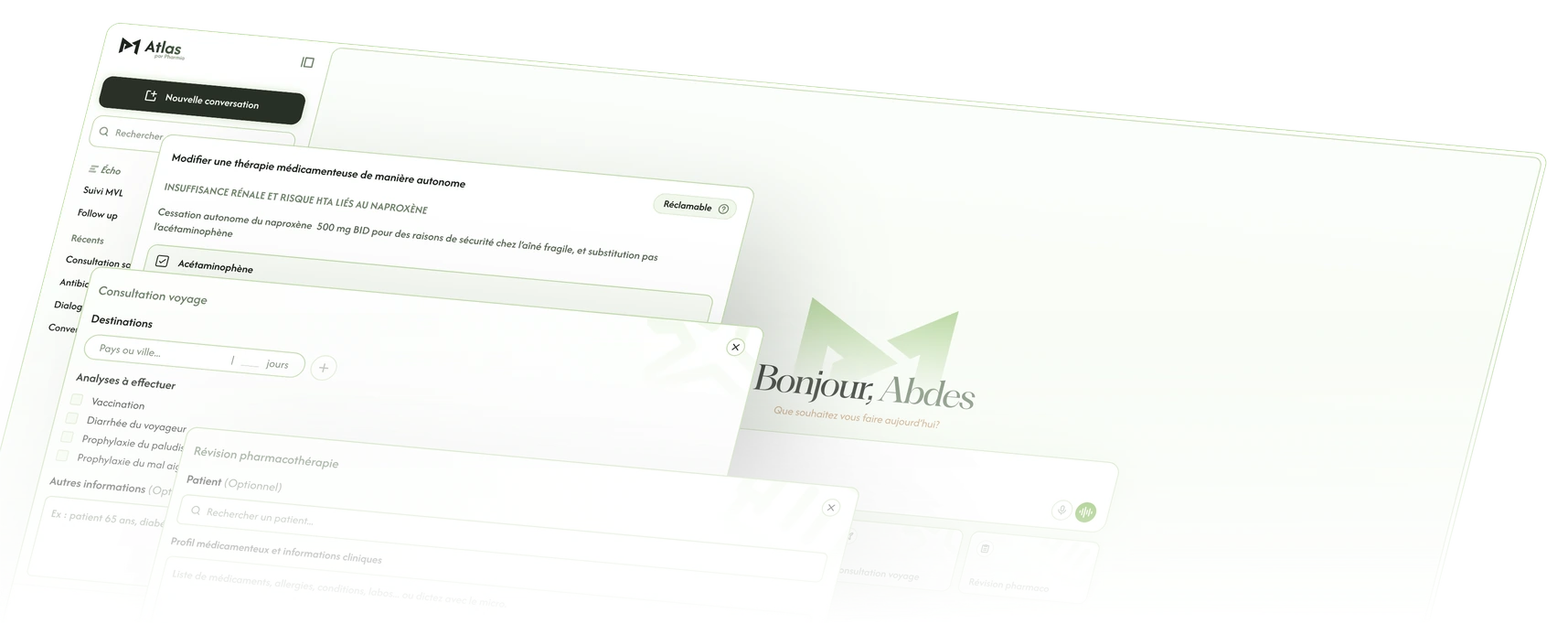
Save time without giving up rigour
Atlas prioritizes relevant Québec references, including the guidelines and standards used in local practice. Your team spends less time searching multiple sources, and more time with patients.
What Atlas lets you do
Clinical research
Ask a question, get a structured, sourced answer, ready to verify.
Medication reviews
The medication list, the issues identified and the evidence supporting your recommendation.
Interaction analysis
Check a combination and get the reasoning, not just an alert.
Travel health consultations
Enter the itinerary and patient profile and get the preventive measures and prophylaxis to consider.
Potentially billable services
On request, Atlas suggests the professional services tied to the consultation and shows, with sources, whether they are billable.
Easier documentation
Generate a structured clinical note from the conversation, ready to review, then copy or print for the record.
Sources suited to our practice
Québec references first; Canadian and international sources cover what they don’t.
High risks: malaria, typhoid (fluoroquinolone-resistant strains), dengue and chikungunya, travellers’ diarrhea, rabies. Japanese encephalitis to consider depending on areas visited.[1]
“Malaria present in all areas below 2,000 m altitude, including New Delhi, with P. falciparum resistance to chloroquine”[2]
Typhoid: vaccination recommended for all travellers to India, including urban areas.[3]
Atovaquone / proguanil is contraindicated if creatinine clearance is below 30 mL/min.[4] Avoid mefloquine with cognitive or mood disorders.[5]
Travellers’ diarrhea: oral rehydration, then azithromycin 1 g PO single dose if severe (frequent fluoroquinolone resistance).[6] Dengue and chikungunya: no chemoprophylaxis; prevention with 20 to 30% DEET and permethrin on clothing.[7]
The pharmacist can prescribe malaria prophylaxis and treatment for travellers’ diarrhea.[8] This medication is generally not covered by the public plan.[9]
Pharmia Atlas turns AI into a true clinical assistant suited to the daily work of Québec pharmacists.
Designed for your practice
Built for Québec pharmacists
Built to help you carry out your clinical tasks under Bills 31, 41 and 67.
Secure data, hosted in Québec
Data is encrypted and hosted in Québec, in line with privacy obligations.
An answer that’s easy to verify
Structured answers with references, quick to validate.
Try it on a real case, not one of ours
A question from your day, in Atlas, with no account needed. It’s the most honest test we can offer.